FLEX Pager OEM Development: What Must Match the Customer’s Network
A FLEX pager is a one-way radio receiver for numeric or alphanumeric messages sent by a compatible FLEX paging network. A new or replacement pager must match the network’s exact frequency, RF configuration, FLEX signaling mode, CAPCODE/address settings, message type, and required functions.
WEX supplies FLEX pagers on a project basis rather than as standard stocked models. Recent production has mainly involved alphanumeric FLEX pagers, while numeric versions can also be developed for specific requirements. Feasibility, samples, pricing, and lead time are evaluated after the customer’s network and product requirements are confirmed.
WEX Primarily Develops Alphanumeric FLEX Pagers, With Numeric Versions Available by Project
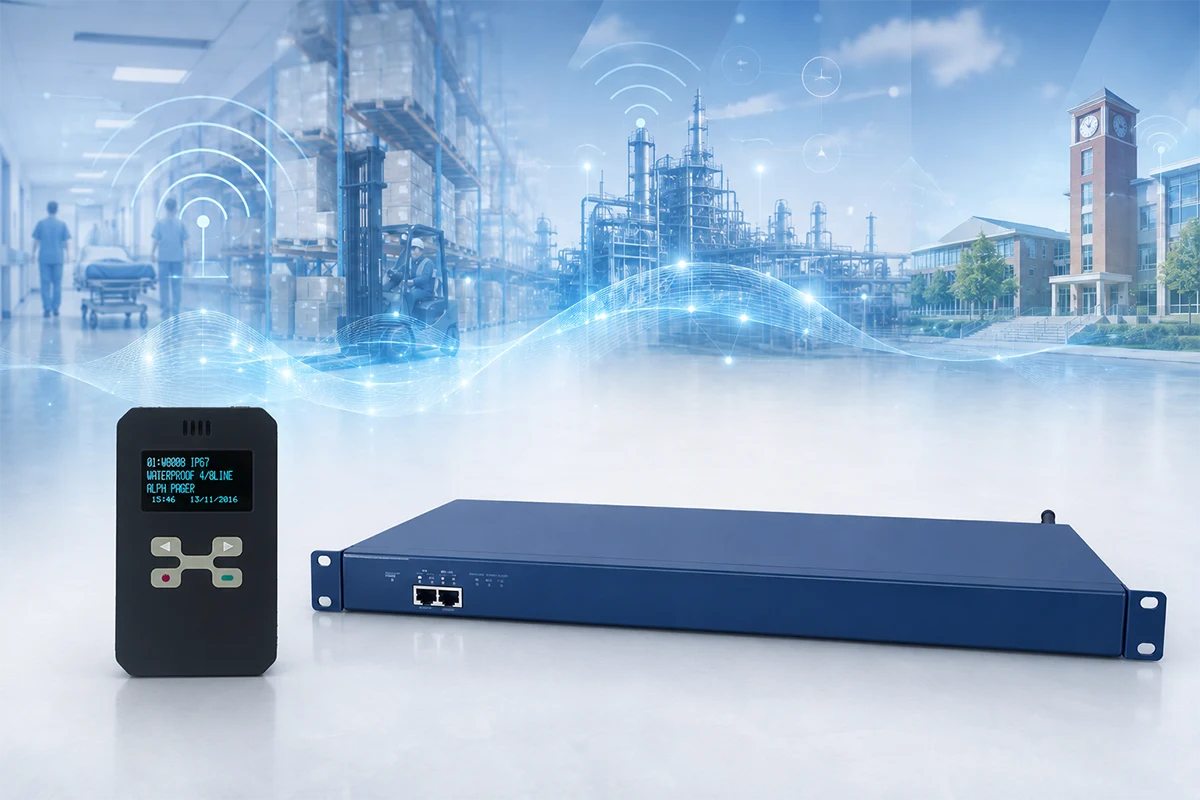
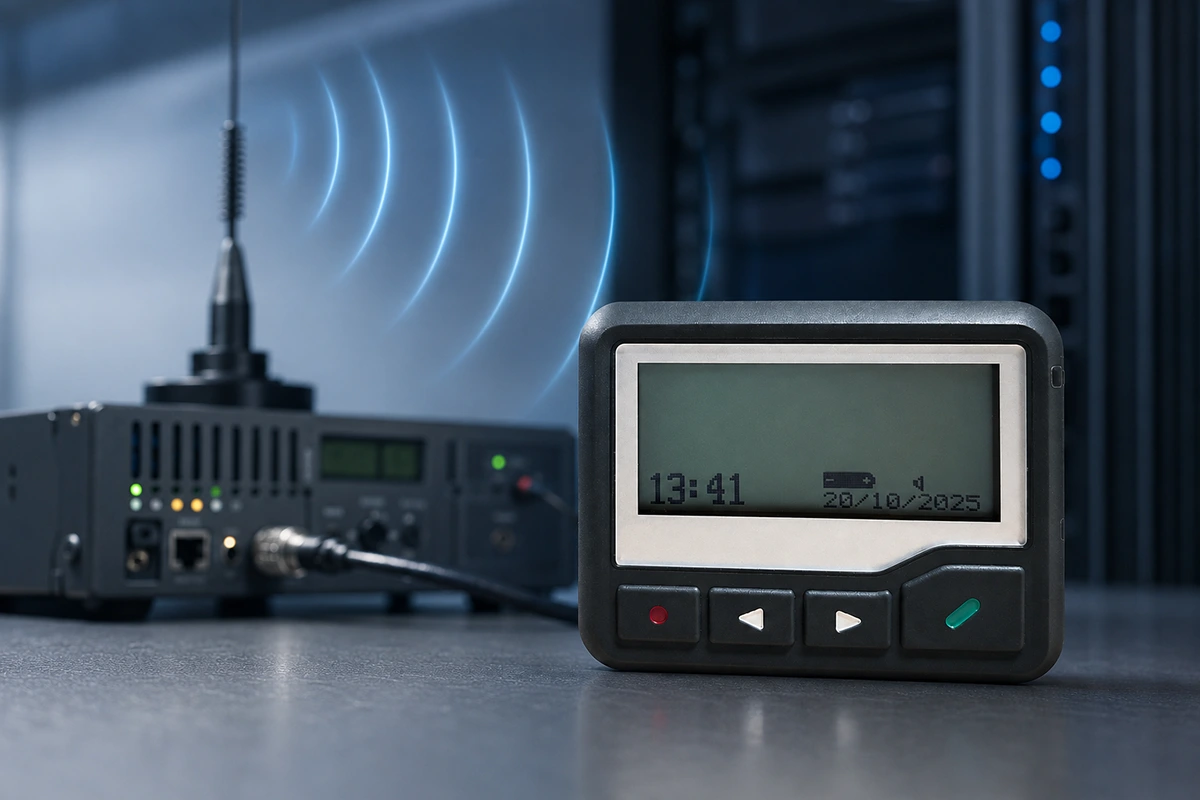
A FLEX pager, sometimes informally called a FLEX beeper, is the receiving end of a paging system. A compatible encoder and transmitter broadcast the message, and the pager recognizes its FLEX address, decodes the data, and alerts the user.
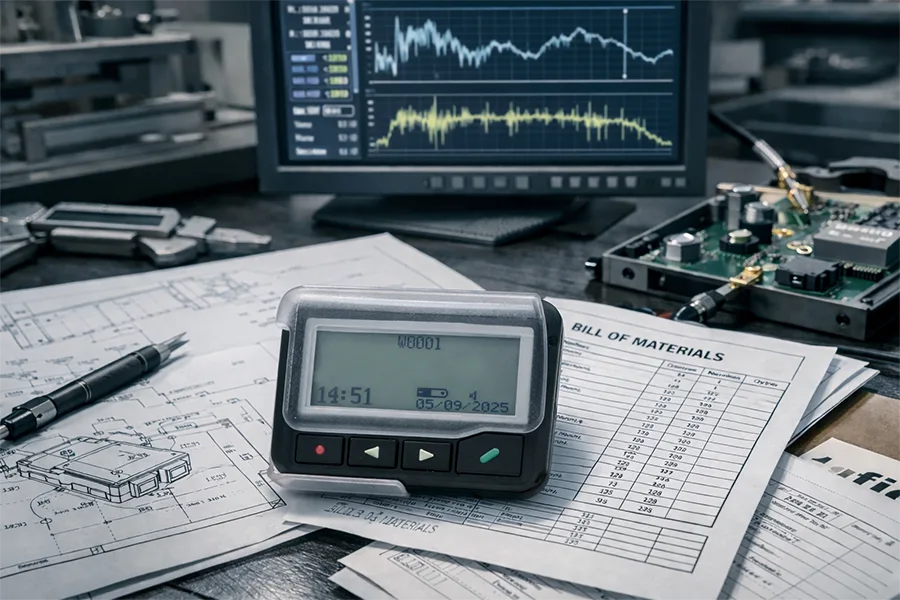
Most current requirements involve a FLEX alphanumeric pager. Its messages can identify a location, person, asset, status, callback number, or requested action. A numeric FLEX pager is more suitable when the workflow only requires a callback number or predefined code. WEX can develop either type, although alphanumeric messaging is now the normal starting point.
FLEX is one-way: the pager receives messages but does not normally acknowledge delivery or allow a reply. ReFLEX is a related two-way protocol and must be treated as a different system requirement.
FLEX pagers are most relevant when an organization already uses a synchronized or wide-area FLEX network for dispatch, public safety, healthcare, facility alerts, or other operational messaging. The pager is not a stand-alone alert system.
WEX has practical production experience with alphanumeric FLEX pagers, including a project completed in 2026. This supports new OEM evaluation without presenting the device as a fixed ready-stock model.
Frequency, FLEX Mode, CAPCODE, and Pager Functions Must All Match
Two FLEX pagers are not automatically interchangeable.
The Exact Frequency and RF Hardware Must Match the Network
FLEX is a protocol, not one fixed frequency. The pager must use the correct RF band and exact network frequency. WEX can evaluate customer-specified frequencies, but the receiver hardware and firmware must support the intended FLEX configuration.
One anonymized WEX OEM project used 148.8125 MHz. This is project evidence, not a general or recommended FLEX frequency. The required frequency depends on the customer’s network and radio regulations.
The Complete FLEX Signaling Mode Must Be Confirmed
FLEX supports four standard modes: 1600/2, 3200/2, 3200/4, and 6400/4. The first number is the bit rate; the second indicates two-level or four-level FSK modulation.
“3200 bps” alone is incomplete because the network may use 3200/2 or 3200/4. The receiver must support the actual mode. Texas Instruments FLEX documentation explains the standard modes and their 2-FSK or 4-FSK operation.
A higher data rate can provide more channel capacity, but it does not automatically provide longer range, lower latency, or better reception. Performance also depends on RF coverage, interference, receiver sensitivity, and network design.
The Complete FLEX CAPCODE and Address Configuration Must Be Available
A FLEX CAPCODE may involve a short or long address, assigned phase, home frame, battery cycle, and other provisioning data. Some values can be derived from a standard CAPCODE; a nonstandard arrangement may require the original programming record. Buyers should provide the complete CAPCODE exactly as provisioned, not only a general “pager number.” Individual and group addresses can be developed according to the project.
Message Type and Pager Functions Must Match the Workflow
The customer must confirm the message type, alerts, message handling, and programming functions. Project-specific software may include frequency, FLEX address, alerts, and other agreed settings, but its software and programming unit are model-specific.
A POCSAG Pager Cannot Be Converted to FLEX Through Programming Alone
POCSAG and FLEX are different over-the-air protocols. POCSAG normally uses 512, 1200, or 2400 bps 2-FSK signaling, while FLEX uses synchronized frames and 1600/2, 3200/2, 3200/4, or 6400/4 modes.
Changing the frequency, baud-rate field, or CAPCODE does not replace the receiver and decoder. A POCSAG pager therefore cannot normally become a FLEX pager through programming alone. Dual-protocol operation requires hardware and firmware deliberately designed for both protocols.
For POCSAG requirements, see POCSAG pager frequencies, baud rate, and capcode. The pager programming guide explains hardware frequency limits and model-specific programming equipment.
WEX Develops FLEX Pagers Around Project-Specific Requirements
WEX does not offer one standard stocked FLEX pager. Each OEM project is evaluated by frequency, signaling mode, address structure, functions, housing, power supply, programming method, and quantity.
Development may include the RF receiver, decoder integration, firmware, display, alerts, power management, housing, software, and programming equipment. Previous projects provide experience, but a new requirement is not assumed to reuse an old product unchanged.
The W2015 and W2016 FLEX receiver and decoder board set supports 928–932 MHz and 1600, 3200, and 6400 bps for OEM integration. It demonstrates current receiver and decoder capability but is not a handheld pager specification.
If the customer also requires a FLEX encoder, transmitter, or another system component, that scope can be evaluated separately. Each production pager is tested against the approved project configuration rather than through sample-based inspection. Commercial terms and production schedules remain project-specific.
Provide Complete Requirements Before Requesting a FLEX Pager
A model name or photograph is helpful, but it is not enough to confirm compatibility. Buyers should provide the following information when available:
| Information to Provide | Why It Is Needed |
|---|---|
| FLEX or ReFLEX | Confirms one-way or two-way requirements |
| Exact frequency and RF band | Determines receiver hardware and configuration |
| FLEX mode | Distinguishes 1600/2, 3200/2, 3200/4, and 6400/4 |
| Complete FLEX CAPCODE | Defines address and frame-related settings |
| Alphanumeric or numeric messages | Determines decoding, display, and firmware requirements |
| Functions and address requirements | Defines messaging, alerts, memory, and programming |
| Existing pager or programming record | Provides a compatibility reference |
| Quantity and project scope | Supports cost, schedule, and system evaluation |
Customers do not need to calculate every FLEX field themselves. An existing working pager, programming sheet, network document, or transmitter specification can help identify missing information.
Feasibility, samples, pricing, and lead time are confirmed after the requirements are reviewed. The general sample-to-production process is explained in what to confirm before OEM pager mass production.
FLEX Pager FAQs
Is a FLEX Pager One-Way or Two-Way?
Ordinary FLEX is one-way: messages travel from the network to the pager. ReFLEX is the related two-way protocol and requires separate evaluation.
Will Any FLEX Pager Work on Any FLEX Network?
No. The exact frequency and RF hardware, FLEX mode, CAPCODE/address configuration, and message functions must be compatible. Matching only the protocol name is not enough.
Can WEX Develop Alphanumeric and Numeric FLEX Pagers?
Yes. Current demand is mainly for alphanumeric FLEX pagers, while numeric versions can be developed when a workflow only requires numbers or predefined codes.
Does WEX Have a Standard FLEX Pager in Stock?
WEX supplies FLEX pagers according to project requirements rather than as one standard stocked model. Specifications, samples, pricing, and lead time are evaluated after the requirements are confirmed.
What Should a Buyer Provide for a FLEX Pager Project?
Provide the frequency, FLEX mode, complete CAPCODE or programming information, message type, required functions, quantity, and available pager or system documents. Also state whether the requirement is for the pager only or includes an encoder or transmitter.
A FLEX pager project should begin with network compatibility, not an assumed model number. Send WEX the available network configuration and product requirements to discuss an OEM FLEX pager project.
How to Send a Message to a Pager
Pager Programming Guide: How POCSAG Pager Configuration Works
Related Article