How a Paging Transmitter Works in a Complete Paging System
Quick Answer
A POCSAG transmitter receives paging data from compatible software, a gateway, an encoder, or a paging controller and broadcasts the message as an RF signal through an antenna. Pagers programmed with the correct frequency, baud rate, capcode/RIC, and message type can then receive and display the alert.
The transmitter is the RF delivery part of the system, not the entire paging system. A professional installation may also require a message source, routing or encoding equipment, an antenna system, programmed pagers, and a response workflow.
What Is a POCSAG Transmitter?
A POCSAG paging transmitter is a radio transmitter designed to send messages using the POCSAG paging protocol. Its main task is to turn properly formatted paging data into an RF signal that compatible pagers can receive within the planned coverage area.
POCSAG stands for Post Office Code Standardisation Advisory Group. It is a one-way paging protocol commonly used for numeric and alphanumeric alerts. Because it is based on broadcast transmission, one message can be addressed to an individual pager or to multiple pagers sharing a group capcode.
Some transmitters include IP, serial, web, or encoding functions. Others depend on a separate paging terminal, gateway, or encoder. Buyers therefore need to confirm both the transmitter specifications and the way messages will enter the paging system.
How a POCSAG Transmitter Works in a Complete Paging System
The basic message path is:
Message Source → Gateway / Encoder / Controller → POCSAG Transmitter → Antenna → Pager
Each component has a different responsibility. Understanding the complete path helps prevent a common purchasing mistake: selecting a transmitter before confirming the message input, pager settings, antenna arrangement, and required coverage.
1. Message Source or Paging Software
The process starts with a message source. This may be a web-based dispatch page, PC software, a nurse call system, a fire alarm panel, a building management system, an industrial monitoring platform, a security console, or a customer-developed application.
The source creates the information to be delivered, such as the event type, location, priority, department, or required action. A manual message might be entered by an operator, while an automated alert may be triggered by an alarm input or another connected system.
2. Gateway, Encoder, or Paging Controller
The gateway, encoder, or controller prepares the message for paging. Depending on the system, it may receive data from an external platform, select an individual pager or group, apply routing rules, assign a priority, convert the message into the required protocol format, and pass it to the transmitter.
Connections may use Ethernet, serial communication, TAP, ESPA, TCP/IP, a web interface, or another supported method. The correct interface depends on the software, controller, transmitter, and customer system, so it should be confirmed before equipment is ordered.
3. POCSAG Transmitter and RF Signal
After receiving compatible paging data, the transmitter modulates and broadcasts the signal on the configured radio channel. Important transmitter parameters can include the frequency band, output power, channel spacing, supported POCSAG data rates, input interface, and antenna connection.
Transmitters may be available in different power levels, but higher wattage does not automatically guarantee reliable coverage. The selected power must be considered together with antenna gain and height, feeder-cable loss, building construction, interference, local licensing requirements, and the size of the site.
4. Antenna and Coverage
The antenna converts transmitter output into a radiated RF signal. Its type, location, height, orientation, feed line, and surrounding structures can all affect reception.
A small single-building system may use a relatively simple antenna arrangement. Hospitals, factories, warehouses, campuses, basements, and multi-building sites may require a site survey, coverage testing, or a more carefully planned antenna system. Increasing transmitter power alone may not correct a poor antenna location or high cable loss.
5. Pager Reception and Capcode Matching
The pager monitors the configured frequency and looks for messages addressed to its capcode, also called a RIC. If the system settings match, the pager alerts the user and displays the numeric or alphanumeric message.
Pagers can be programmed for individuals, departments, or groups. For example, one alert may be sent to a single maintenance engineer, while another is sent to every member of an emergency response team. Address planning should therefore be completed before large quantities of pagers are programmed.
POCSAG Transmitter vs. Complete Paging System
A POCSAG transmitter is one component in the communication chain. It provides RF transmission, but it does not automatically provide every function needed for message creation, routing, logging, escalation, user permissions, or acknowledgment.
A complete professional system may include paging software, a terminal or gateway, an encoder, the transmitter, RF accessories, an antenna, programmed pagers, and integration with external alarm or monitoring systems. Some products combine several of these functions, but the complete architecture must still be checked as a system.
This distinction is important when replacing an existing transmitter. A new unit must be compatible not only with the pagers, but also with the existing input method, controller, protocol, frequency plan, antenna system, and operational workflow.
What Must Match Between the Transmitter and Pagers?
Frequency and Radio Band
The transmitter and pagers must operate on compatible frequencies. The selected channel must also comply with local radio regulations and licensing requirements. Do not assume that two POCSAG products are compatible simply because they use the same protocol.
512, 1200, and 2400 Baud
POCSAG commonly uses 512, 1200, or 2400 bps. The transmitter configuration and pager programming must support the selected rate. Lower data rates take longer to send a message, while higher rates transmit data more quickly, but the final choice should follow the complete system design and receiver compatibility.
Capcode or RIC
The capcode/RIC identifies the pager or pager group that should receive a message. Incorrect or duplicated address planning can send alerts to the wrong users or prevent the intended pager from responding.
Numeric and Alphanumeric Messages
The message format must match the pager capability. Numeric pagers display numbers or predefined codes, while alphanumeric pagers display text. Buyers who need more detail can review the guide to POCSAG pager frequencies, baud rate, and capcode.
Does a POCSAG Transmitter Need Software or Internet?
A transmitter needs a compatible source of paging data, but it does not always need public internet access. A local PC, serial encoder, paging terminal, alarm controller, or on-site network can provide messages without using the internet.
Internet or IP connectivity may be used when a system sends messages from a browser, cloud platform, remote dispatch location, or network-connected controller. Even then, the internet or IP network normally carries the message to the paging equipment; the final delivery from the transmitter to the pager remains an RF broadcast.
When evaluating a project, ask how the message is created, which interface carries it to the transmitter, whether operation must continue during a network outage, and which functions must remain local.
What Affects POCSAG Transmitter Coverage?
Coverage depends on the complete RF path rather than transmitter wattage alone. Important factors include operating frequency, output power, antenna gain and height, cable type and length, building materials, terrain, interference, receiver sensitivity, and local installation rules.
Metal structures, reinforced concrete, underground areas, equipment rooms, and separate buildings can create difficult reception zones. A transmitter that performs well in an open area may need a different antenna position or system design inside a complex facility.
Before final selection, define the required coverage area and identify critical rooms or zones. The guide on how to choose a POCSAG paging transmitter explains the broader selection process for new systems and transmitter replacements.
POCSAG Transmitter Project Checklist
Before requesting a quotation, buyers and system integrators should document how messages enter the system, where they must be received, and which pagers or groups should respond. This reduces compatibility problems and helps suppliers recommend the correct hardware.
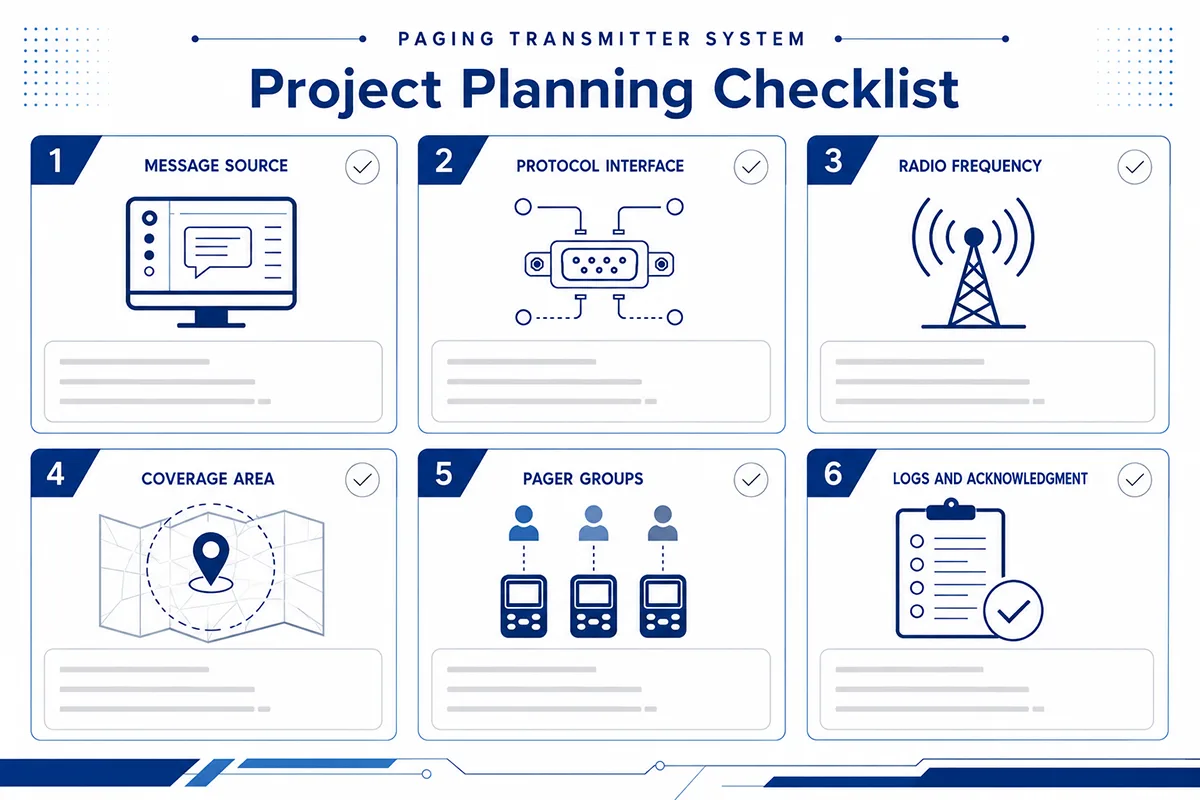
| Item to Confirm | Why It Matters |
|---|---|
| Application and site | Hospitals, factories, warehouses, campuses, and security sites have different coverage conditions. |
| Message source | Identify whether messages come from software, a web page, an alarm panel, a monitoring platform, or manual dispatch. |
| Interface and input protocol | Confirm Ethernet, serial, TAP, ESPA, TCP/IP, web-based messaging, or another supported method. |
| Frequency and local rules | The transmitter and pagers must match, and the selected channel must be authorized for the location. |
| Output power and antenna | Coverage depends on power, antenna position, antenna gain, cable loss, building structure, and interference. |
| Baud rate and message type | Confirm 512, 1200, or 2400 bps and whether messages are numeric or alphanumeric. |
| Pager quantity and capcode plan | Define individual addresses, group addresses, departments, and emergency groups before programming. |
| Logs and acknowledgment | Standard one-way POCSAG pagers do not return acknowledgments; additional software or two-way devices may be required. |
Frequently Asked Questions
What Does POCSAG Stand For?
POCSAG stands for Post Office Code Standardisation Advisory Group. The name is now commonly used for the one-way radio paging protocol associated with numeric and alphanumeric pager messages.
What Is the Function of a POCSAG Transmitter?
Its function is to broadcast properly encoded paging messages as RF signals so that compatible pagers within the coverage area can receive them.
What Frequencies Do POCSAG Transmitters Use?
POCSAG can be used on different licensed paging channels and bands. The exact frequency depends on the equipment, pager programming, local spectrum plan, and regulatory approval. Always confirm the required frequency before ordering.
Can One Transmitter Send to Multiple Pagers?
Yes. A transmitter can broadcast messages addressed to individual capcodes or group capcodes. All pagers within coverage receive the broadcast signal, but only correctly programmed devices respond to the relevant address.
Can a POCSAG Pager Acknowledge a Message?
A standard one-way POCSAG pager cannot transmit a reply, delivery receipt, or online status. Projects requiring acknowledgment need an additional return channel, software workflow, mobile or network-connected device, or another two-way communication method.
Planning a Professional POCSAG Paging Project
WEX supports professional paging projects with alphanumeric POCSAG pagers, transmitter options, pager programming, frequency and capcode configuration, accessories, and project-based hardware support.
Before selecting equipment, share the application, country, required frequency, coverage area, message source, input interface, pager quantity, baud rate, capcode plan, and acknowledgment requirements. These details make it easier to determine whether the project needs only a transmitter replacement or a more complete paging-system configuration.
Conclusion
A POCSAG transmitter converts compatible paging data into an RF broadcast, but reliable message delivery depends on the complete chain: message source, gateway or controller, transmitter, antenna, pager programming, and response workflow.
Start by defining where the message comes from, how it enters the paging equipment, which areas need coverage, and which pagers should receive it. Once those requirements are clear, transmitter power, frequency, interfaces, antenna setup, and pager configuration can be selected as parts of one coordinated system.
Echo3 PoC Radio for Team Communication After Paging Alerts
How Hospital Paging Systems Support Emergency Communication During IT Downtime
Related Article