When Did Pagers Come Out? From Beeps to Text Messages
Quick Answer
Al Gross invented the telephone pager in 1949, and New York’s Jewish Hospital adopted his system in 1950. The familiar consumer beeper belonged to a later period: pagers became widely associated with everyday mobile communication during the 1980s and 1990s. Their history spans several developments, from an alert that prompted a callback to devices displaying numbers, text and, in some models, reply options.
When Were Pagers Invented—and Who Invented Them?
The telephone pager emerged from earlier work on one-way mobile radio.
In April 1928, Detroit police began regular one-way radio communication with patrol cars. IEEE records this as a land-mobile radio milestone. The system established a practical way to dispatch officers while they were on the move.
The more direct milestone is 1949, when Al Gross invented and patented a telephone pager that responded selectively to particular signals. MIT’s account of his work records its adoption by New York’s Jewish Hospital in 1950.
Motorola’s official timeline documents another step in 1955: a paging system with individual pocket receivers for hospitals, factories and offices.
Radio dispatch established the principle; selective pocket receivers brought it to individual users.
From Beeps to Numbers, Text and Replies
Paging developed along two important dimensions: how much information the receiver could present, and whether it could transmit a response.
| Pager type | What the user received | Typical next action |
|---|---|---|
| Tone-only | An audible alert | Follow an agreed instruction or call a known contact |
| Tone-and-voice | An alert followed by spoken information | Act on the instruction or respond through another channel |
| Numeric | A callback number or agreed numeric code | Find a telephone and call back, or interpret the code |
| Alphanumeric | Letters and numbers forming a readable message | Read the details and take the requested action |
| Reply-capable or two-way | A message plus supported response functions | Acknowledge or reply according to the device and service |
Tone, voice, numeric and text pagers served different communication needs.
Alphanumeric describes the display; one-way and two-way describe the communication. A one-way text pager displays complete instructions, while a two-way pager also transmits responses. Motorola records the 1995 Tango as a two-way pager supporting text and email reception with preset replies.
This progression explains why memories of pagers range from a simple beep to phone numbers, written instructions and replies.
When Were Pagers Popular, and How Did People Use Them?
Consumer beepers became a familiar part of mobile communication in the 1980s and 1990s. In Japan, NTT DOCOMO’s paging service reached approximately 6.49 million subscribers in 1996.
For a numeric pager subscriber, a typical exchange was straightforward. Someone called the assigned pager number, followed the service prompt and entered a callback number. The receiver displayed the digits; its owner then found a telephone and returned the call.
Users also developed shared numeric codes. Personal recollections describe 143 for “I love you” and 911 for an urgent callback, alongside codes agreed within families and groups of friends.
Text-capable devices added written details to the alert. For telephone entry, gateways and private systems, see how to send a message to a pager.
Why Did Pagers Become Part of Everyday Life?
Pagers met a practical need before mobile phones became an everyday purchase: reaching someone away from a fixed telephone. Families and friends could request a callback without knowing where that person was. A pocket receiver made this useful beyond professional on-call work.
Receive-only operation also kept the task focused. The network sent a radio message; the pager checked its programmed address and alerted for a matching page. It did not establish a two-way voice call. This supported a compact device dedicated to short notifications.
Battery-saving techniques helped make regular carrying practical. For example, FLEX pagers could check assigned transmission periods rather than decode every period continuously. This reduced the time spent actively receiving and decoding signals, helping conserve battery power.
Affordability and social appeal also mattered. In the Netherlands, youth-oriented pricing, colorful devices and intensive marketing helped bring pagers into the consumer market. Being reachable became part of the appeal of owning one, extending its role from a work tool to a personal accessory.
Why Did Pagers Fade from Everyday Communication?
The same design that made a numeric pager useful also limited it: notification arrived on the pager, but a conversation usually required another telephone.
As mobile calls and SMS became more accessible, a handset could handle both stages. People could receive a request and respond from the same device. Two-way pagers added replies; mobile phones combined messaging with voice calls in the same handset.
NTT DOCOMO’s figures show the scale and pace of the retreat in its Japanese service: subscriptions peaked in 1996 and fell to about 290,000 by March 2005. Citing declining subscriptions and operational efficiency, NTT DOCOMO’s service announcement set the end date for March 2007.
Service closures also removed the infrastructure that delivered messages to subscribers. This is why a vintage pager that still powers on needs an active, compatible system to receive pages.
Why Did Some Medical and Emergency Workflows Keep Paging?
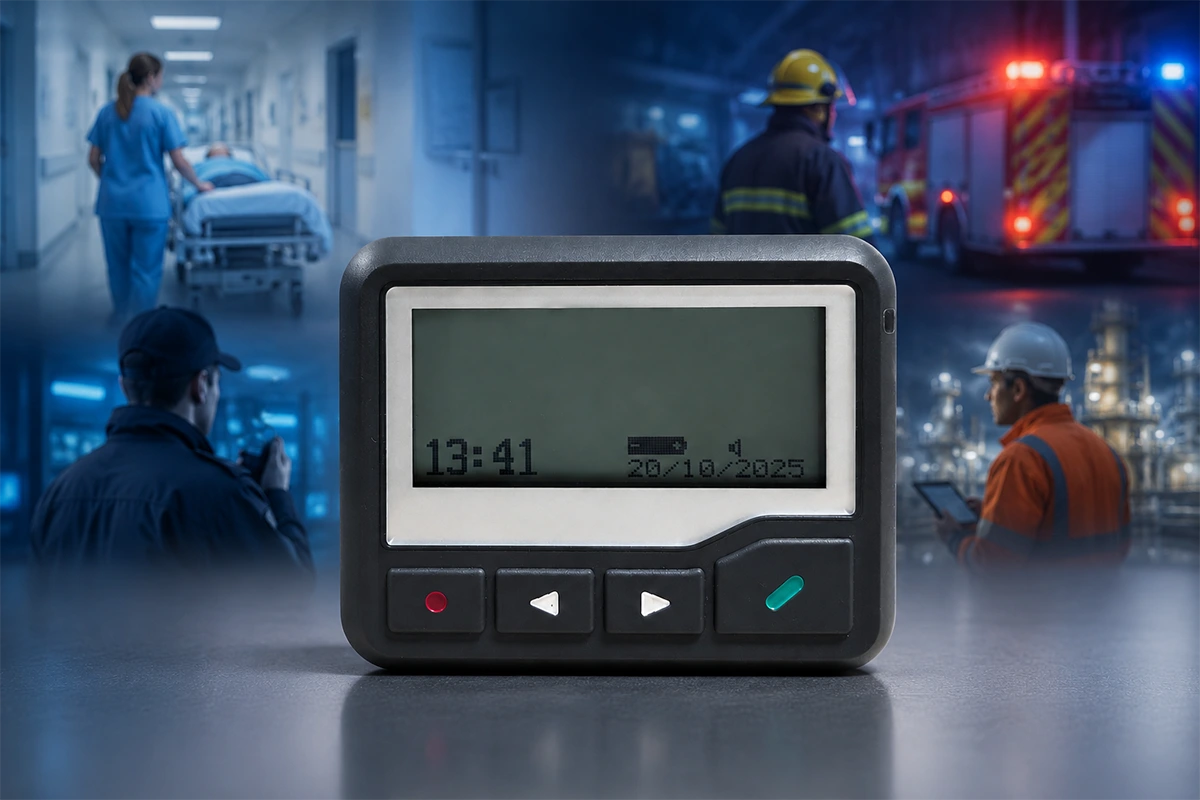
Routine clinical coordination involves discussion, task allocation and replies. Emergency paging serves a narrower purpose: alerting the people assigned to respond.
In the pilot of Grey’s Anatomy, Bailey’s rule for the new interns is memorable: “answer every page at a run.” Even walking is too slow for Bailey. The scene captures paging’s practical role: a nurse can summon a doctor elsewhere in the hospital without first tracking them down.
Hospitals can replace routine messaging while retaining emergency calls
A 2023 Cambridge University Hospitals report describes replacing non-emergency bleeps with an electronic-health-record-integrated messaging system. The project excluded cardiac arrest, major trauma and fire calls from replacement.
The hospital separated routine collaboration from emergency team notification, retaining distinct communication arrangements for those tasks.
Emergency notification has its own requirements and limitations
NPSTC’s public-safety paging paper discusses simultaneous personnel notification and reaching responders dispersed across areas with inconsistent cellular service. It also identifies an important limitation: traditional one-way paging provides no acknowledgment that a recipient received or acted on a message.
Fire-service voice paging delivers spoken dispatch instructions; text paging presents details on a screen. For one-way receivers, response confirmation requires a separate communication channel.
Paging retained a role in personnel notification as phones and messaging applications took over more of the conversation and coordination.
What Does Pager History Explain About Devices Today?
Pager history helps separate three questions: what a device looks like, what it can display, and how its communication system operates.
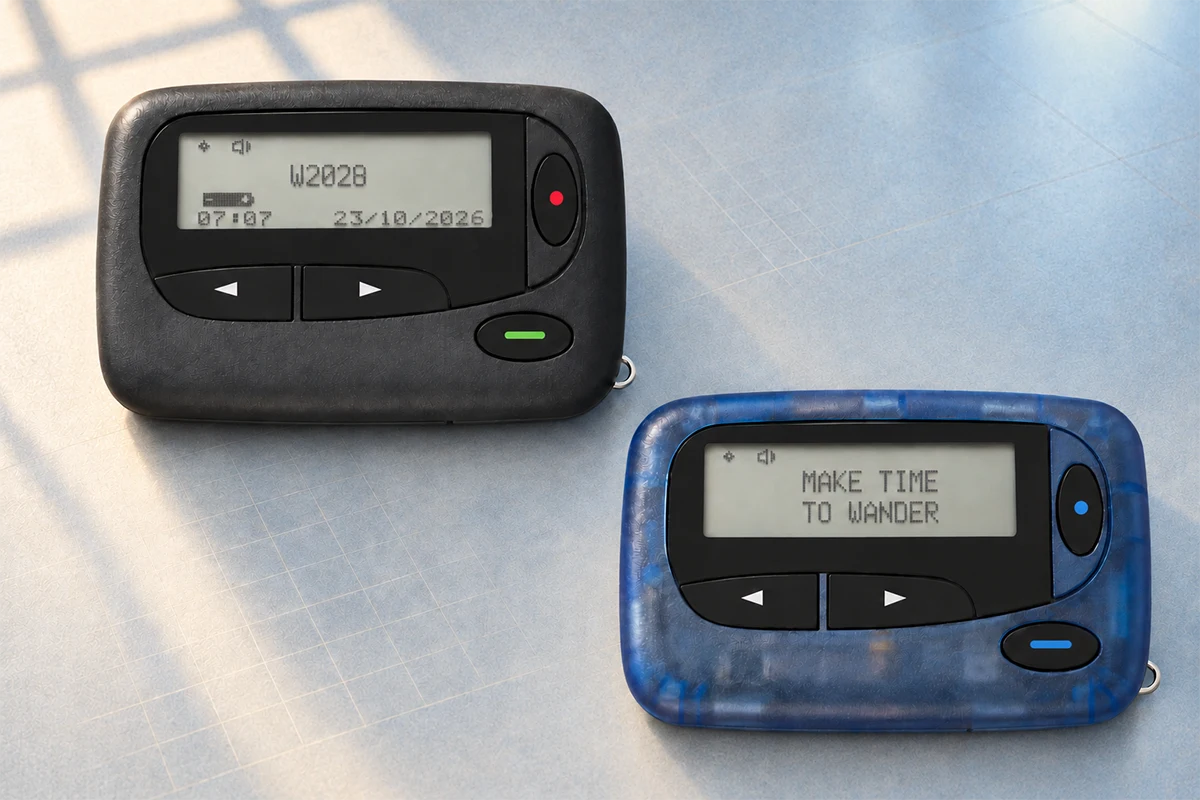
Classic pager designs remain in production, and one-way text reception remains a distinct function. The modern product range includes both operational alert receivers and customized devices built around stored content.
For contemporary alert-receiving equipment, compare WEX’s alphanumeric pager models. For projects centered on the familiar appearance and customer-defined content, see classic pager designs for custom merchandise.
The intended task determines the required functions: a radio receiver for operational alerts, a transmit-and-receive device for two-way messaging, or stored content and controls for a merchandise project.
Related Article