Where Pagers Fit in Construction, Event, and Security Communication
Quick Answer
Construction sites, event teams, and security operations usually depend on radios, mobile phones, push-to-talk applications, and dispatch systems because their work often requires immediate two-way communication.
A pager is generally not a replacement for these tools. However, it may serve as a supplementary alert endpoint when a team needs to send a short, one-way message to a known person or group. This only makes sense when the sender, recipient, follow-up procedure, and paging infrastructure are clearly defined.
What These Teams Normally Use
The right communication tool depends on whether a task requires a short alert, a detailed instruction, or an immediate reply. For a broader comparison, see how radios, PoC devices, pager alerts, and other communication channels support different types of work.
Construction Sites
Construction teams frequently need to discuss changing hazards, equipment movement, work schedules, access restrictions, and task coordination. Radios are often more practical for urgent voice communication, while phones, group messaging, and project platforms support less urgent updates and documentation.
A standard one-way pager cannot carry a conversation or confirm that a worker understood an instruction. It should therefore not be treated as the primary tool for coordinating active construction work.
Events and Venues
Event staff may need to coordinate entrances, stages, technical crews, guest services, medical support, and security. Walkie-talkies with earpieces, mobile phones, and push-to-talk applications allow teams to exchange information and respond quickly.
An event staff pager may be useful only for a narrowly defined notification. For example, a predefined support role could receive a short request and then respond through a radio or phone. Adding a pager without a clear response process would create another communication step rather than solve the problem.
Security Operations
Security teams commonly work through dispatchers, radios, assigned call signs, phones, and incident procedures. Requests for assistance usually require confirmation, updated information, and continued coordination.
A security staff pager cannot replace the radio used during an active incident. It may only support a fixed one-way alert workflow, such as notifying a designated supervisor that an alarm requires attention. The operational response must continue through an appropriate two-way channel.
Where a Pager Could Still Fit
A pager may be considered when all of the following conditions apply:
- The message is short and primarily intended to attract attention.
- The correct recipient or paging group is known in advance.
- The recipient does not need to reply through the pager.
- A radio, phone, or dispatch procedure is available for follow-up.
- A compatible paging transmitter and message source already exist or are planned.
- The organization has a clear procedure for missed, delayed, or unanswered alerts.
For example, a fixed facility might send a short maintenance notification to a designated technician. A venue could notify a predefined technical-support role without broadcasting the message to every radio user. A security system might alert a supervisor before the team continues coordination by radio.
These are possible workflow designs, not evidence that pagers are widely used across every construction site, event, or security operation.
What a Pager Cannot Replace
A one-way pager is usually unsuitable when the task requires:
- Immediate questions and answers
- Confirmation that instructions were received
- Detailed or rapidly changing directions
- Live worker or vehicle location
- Continuous coordination between several teams
- Voice communication during an active emergency
- Temporary deployment where no paging transmitter is available
Poor cellular coverage alone is not enough reason to purchase pagers. The organization must first determine how messages will enter the paging system, who will receive them, and what the recipient must do next.
A pager also should not be presented as a substitute for required alarm, evacuation, emergency-response, or life-safety systems.
A Practical Fit Check
The following questions help determine whether a pager belongs in the planned workflow.
| Pager Communication Fit Check | |
|---|---|
| Question | What the Answer Means |
| Is the message genuinely one-way? | If yes, a pager may be considered. If a reply is required, use a two-way tool. |
| Are the sender and recipient known? | Individual or group pager addresses can be planned in advance. |
| Is a follow-up channel defined? | The recipient should know whether to call, use a radio, or contact dispatch. |
| Is acknowledgement required? | A standard one-way pager cannot provide delivery or response confirmation. |
| Is compatible paging infrastructure available? | Confirm the transmitter, protocol, frequency, programming, and message source. |
| Is the main requirement live coordination? | A radio or push-to-talk solution will usually be more appropriate. |
This evaluation should happen before selecting a pager model. Starting with the workflow prevents a team from purchasing a device that does not match its operational needs.
Where the WEX W8008 Fits
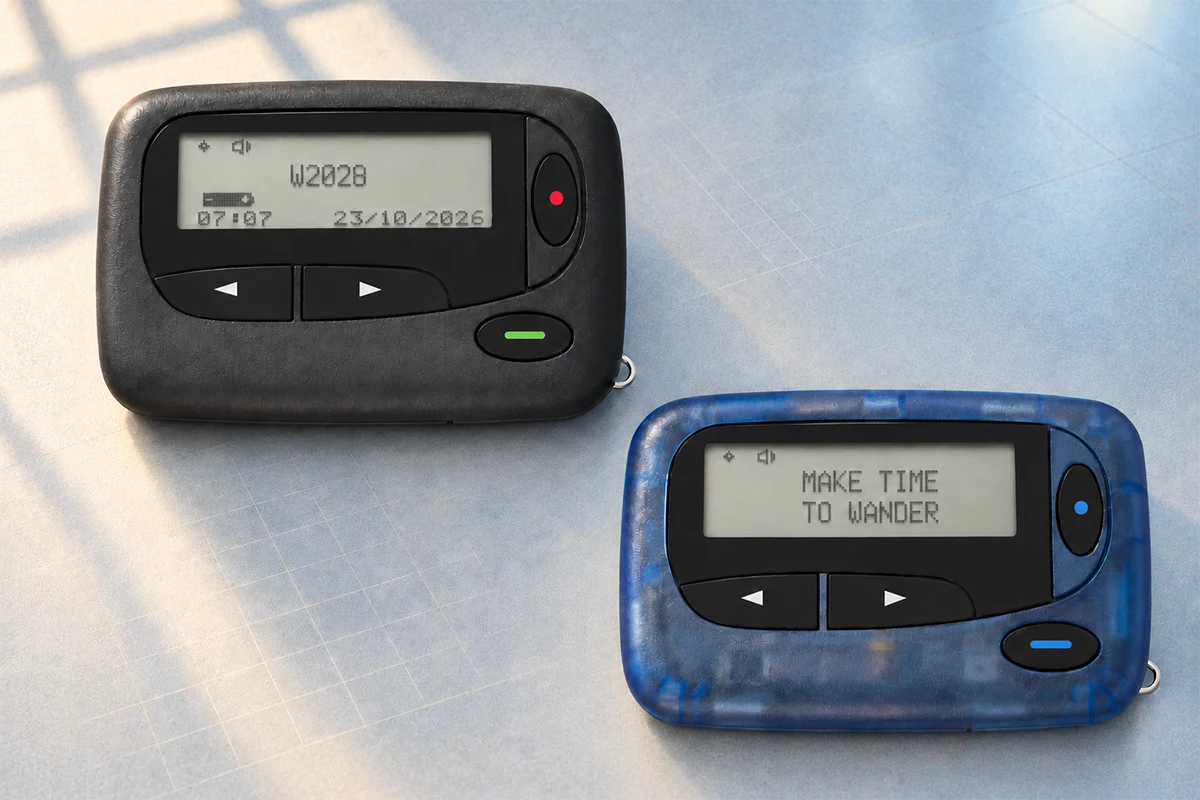
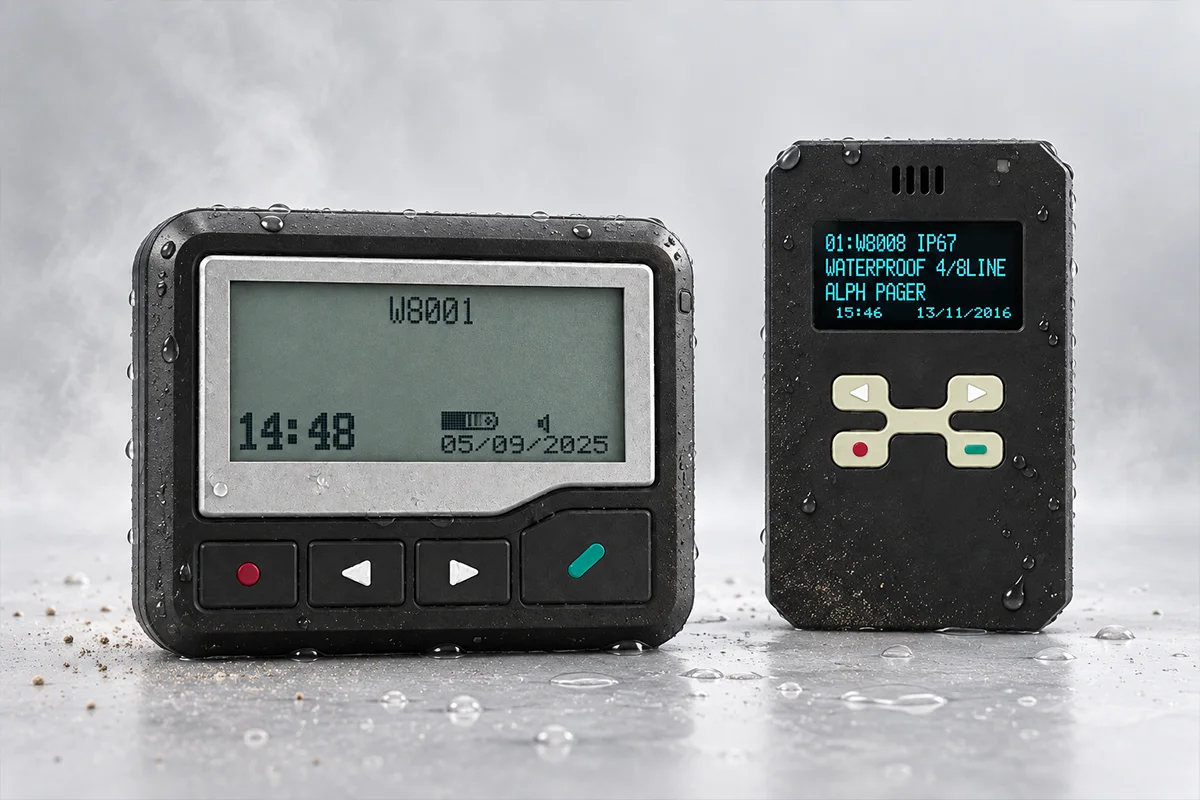
The WEX W8008 IP67 POCSAG alphanumeric pager is intended to receive short text alerts from a compatible paging system. It is an endpoint, not a complete communication system.
Before considering the W8008, buyers should confirm:
- Transmitter frequency compatibility
- Supported POCSAG settings and baud rate
- Pager address or capcode programming
- The source that will create and send messages
- Coverage within the intended operating area
- The procedure staff will follow after receiving an alert
The W8008 does not provide voice communication or a standard on-device acknowledgement function. It should therefore be considered only when a one-way alert fits the planned workflow. Its environmental rating does not remove the need for coverage testing and site-specific evaluation.
Frequently Asked Questions
Are Pagers Commonly Used on Construction Sites?
Pagers are not normally the primary communication tool on construction sites. Radios, phones, and project communication platforms are generally better suited to active coordination. A pager may support a specific one-way alert process, but it should not be described as a standard site-wide solution.
Can a Pager Replace Event Staff Radios?
Usually not. Event staff often need to ask questions, confirm instructions, and report changing conditions. A pager may deliver a short notification to a predefined role, but two-way communication is still needed for the response.
When Might a Security Team Consider Pager Alerts?
A pager may be considered when a fixed-site system needs to send a discreet, short alert to a known supervisor or response group. The team must still have a defined radio, phone, or dispatch procedure for handling the incident.
Conclusion
Construction, event, and security teams usually require faster two-way coordination than a standard pager can provide. Radios, phones, push-to-talk applications, and dispatch systems should remain the primary communication tools in most of these environments.
A pager may still have a limited supporting role when the message is short, one-way, directed to a predefined recipient, and connected to a clear follow-up procedure.
Before purchasing a pager, define the message source, recipient, response action, infrastructure, and acknowledgement requirements. If those elements are unclear, adding a pager is unlikely to improve the communication process.
Pagers in 2026: Why POCSAG and Alphanumeric Pagers Still Matter
Related Article