PoC Radio vs Traditional Two-Way Radio: What Is the Difference?
Quick Answer
A traditional two-way radio usually uses local VHF or UHF radio frequencies, while a PoC radio uses cellular or data networks such as LTE, SIM-based service, or Cloud SIM. Traditional two-way radios are better for local RF communication, while PoC radios are more suitable for mobile teams that need wider-area push-to-talk communication where network service is available.
Many buyers use walkie-talkie, two-way radio, PTT radio, and PoC radio almost interchangeably.
This is understandable. These devices may look similar from the outside. They are handheld, support push-to-talk voice communication, and are often used by security, facility, logistics, and field teams.
But for product selection and project planning, they are not always the same.
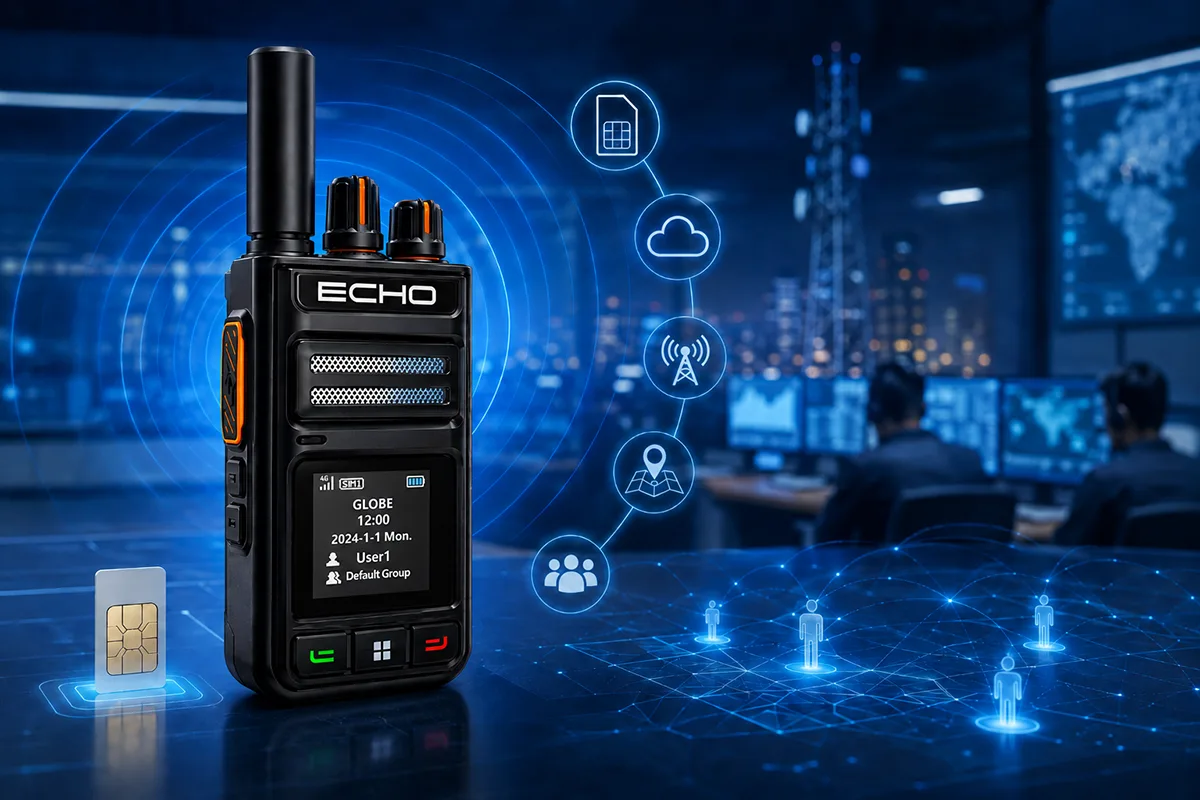
A traditional two-way radio usually relies on a local RF system such as VHF or UHF. A PoC radio, or Push-to-Talk over Cellular radio, uses cellular or data networks such as LTE, SIM-based service, or Cloud SIM service.
The difference affects coverage, deployment, SIM card requirements, network planning, accessories, and daily operation.
For buyers, the real question is not simply:
Which radio is better?
The better question is:
Which communication method fits the way your team works every day?
The Core Difference: RF Network vs Cellular Network
The simplest difference is this:
Traditional two-way radios use local RF communication. PoC radios use cellular or data networks.
Traditional two-way radios communicate through radio frequencies. Depending on the system, they may work directly between radios or through repeaters and antenna systems. Their performance depends on frequency planning, output power, terrain, building structure, interference, antenna position, and local radio regulations.
PoC radios work differently. They use LTE, cellular data, SIM card service, Cloud SIM, or other network-based services to support push-to-talk communication.
When network service is available, PoC radios can support wider-area communication without relying only on one local RF coverage zone.
| Item | Traditional Two-Way Radio | PoC Radio |
|---|---|---|
| Communication method | VHF / UHF radio frequency | LTE / cellular data / Cloud SIM |
| SIM card | Usually not required | Usually required or supported by Cloud SIM |
| Coverage | Depends on RF range, repeaters, terrain, and antennas | Depends on cellular or data network availability |
| Deployment | Frequency planning, antennas, repeaters | Network service, SIM / Cloud SIM, user groups |
| Best for | Local site communication | Wider-area mobile team communication |
| Main limitation | RF coverage and licensing may need planning | Network availability is critical |
Neither option is automatically better. They solve different deployment problems
When Traditional Two-Way Radio Makes More Sense
Traditional two-way radios may be a better fit when users mainly work in one fixed local area and need communication through a dedicated RF system.
They are often used in factories, campuses, construction sites, hotels, event venues, warehouses, and industrial facilities.
Traditional two-way radio may be more suitable when:
- the site already has a VHF / UHF radio system
- users need local communication without relying on cellular networks
- mobile network coverage is weak
- the customer already has repeaters, antennas, or frequency resources
- the team mainly communicates within one building, campus, or operating area
In these cases, traditional radio can provide strong local communication when properly planned.
However, it may require frequency coordination, antenna planning, repeater deployment, licensing review, and coverage testing depending on the region and application.
So the advantage is not simply “no SIM card.” It is a different system model.
When PoC Radio Makes More Sense
PoC radio is often considered when users need push-to-talk communication across wider areas, especially when the team is mobile.
For example, a security company may manage staff across several buildings. A logistics team may move between warehouses, loading areas, and delivery routes. A facility team may support multiple sites in one city. A field service team may need communication while moving between customer locations.
PoC radio may be a good fit when buyers need:
- LTE-based push-to-talk communication
- SIM-based or Cloud SIM communication
- wider-area team coordination
- group calls for teams or departments
- selective calls for one-to-one communication
- dispatcher messages from a control side
- quick switching between communication groups
- easier cross-region operation
This does not mean PoC radio has unlimited coverage. It still depends on cellular or data network availability.
A more accurate way to explain it is:
PoC radio can support wider-area communication where network service is available.
Why SIM Card and Cloud SIM Matter
One common question is:
If a radio needs a SIM card, is it still a two-way radio?
Yes, but it is a different type of two-way communication device.
A SIM-based PoC radio is still used for two-way voice communication. However, it does not work like a traditional VHF / UHF radio. It uses cellular or data network service to connect users and groups.
This changes what buyers need to confirm.
For a traditional two-way radio, buyers often confirm frequency, power, channel spacing, antenna, repeater, and local radio regulations.
For a PoC radio, buyers should confirm network environment, SIM or Cloud SIM service, operator availability, user groups, dispatcher needs, and platform or service settings.
Cloud SIM can reduce the need to manually manage physical SIM cards. Multi-operator compatibility can also help when users move between different areas where one operator may not always provide the strongest signal.
However, buyers still need to confirm whether the working area has suitable network coverage.
Where Echo3 Fits in This Comparison
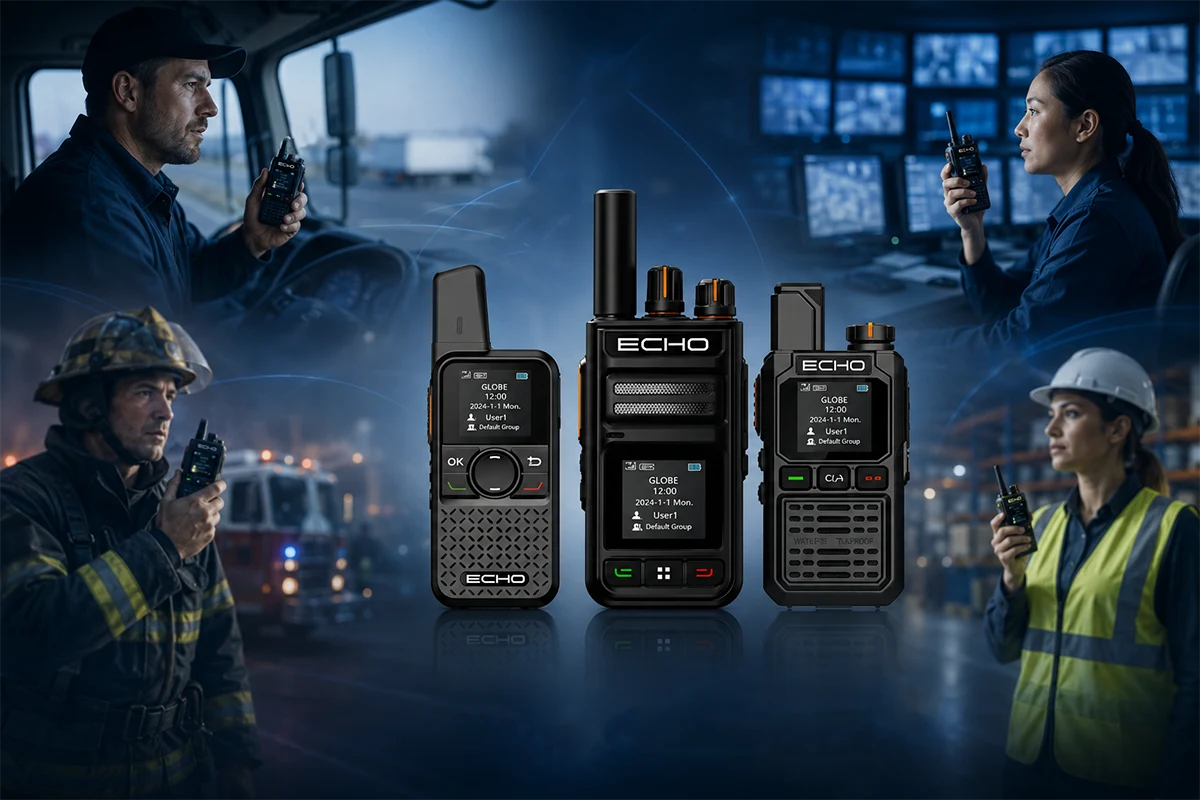
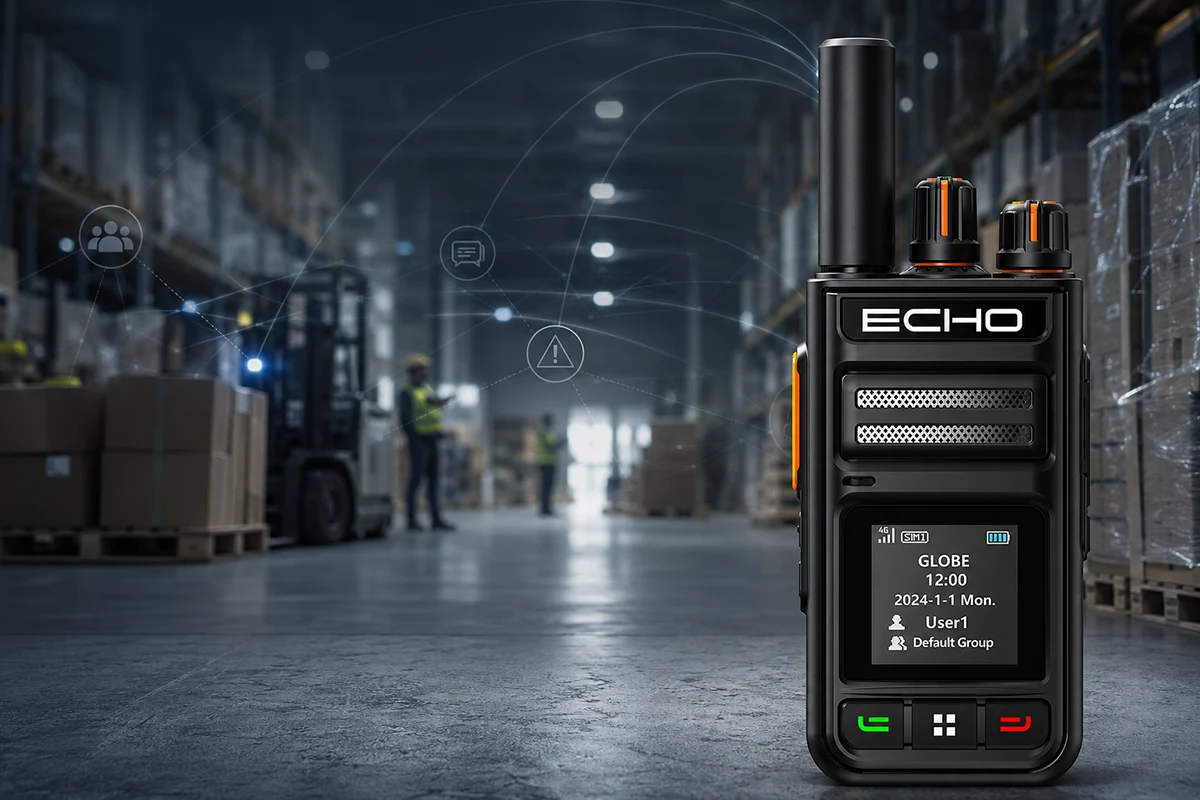
Echo3 belongs to the PoC radio category. It is suitable for buyers looking for an LTE-based, SIM / Cloud SIM supported push-to-talk device for mobile team communication.
It should not be described as a traditional VHF / UHF two-way radio.
Echo3 is designed for practical field communication features such as:
- Group Call
- Selective Call
- Dispatcher Message
- Fast Charge
- Quick Group Switching
These functions are useful when users need to communicate in groups, contact one person directly, receive instructions from a control side, or switch between different team groups during daily work.
For example, one user may need to switch between:
- Security Patrol Group
- Maintenance Group
- Emergency Support Group
- Management Group
In this workflow, quick group switching can reduce delay and confusion.
Echo3 also uses a compact handheld design with a 1.44-inch display, Type-C charging, and a 2600mAh battery. Its operating temperature range of -20°C to 60°C makes it suitable for common professional field communication environments.
Echo3 is not meant to replace every traditional radio system. It is more suitable for buyers who need LTE, Cloud SIM, multi-operator support, and flexible team coordination. If you are comparing SIM-based PoC radios with traditional two-way radios for a project, WEX can help review the basic application environment, user group needs, and Echo3 configuration options before quotation.
How to Choose: Start with the Working Environment
Before choosing between a traditional two-way radio and a PoC radio, buyers should start with the working environment.
| Question | If the Answer Is Yes, Consider |
|---|---|
| Do users mainly work in one local site? | Traditional two-way radio |
| Do users move across different sites or regions? | PoC radio |
| Is cellular or data network coverage available? | PoC radio |
| Does the team need communication without relying on operators? | Traditional RF radio |
| Does the project need group calls or dispatcher messages? | PoC radio |
| Does the customer already have VHF / UHF infrastructure? | Traditional radio |
| Does the team need SIM / Cloud SIM flexibility? | PoC radio |
This checklist helps avoid a common mistake: choosing a device based on appearance instead of communication logic.
A PoC radio may look like a walkie-talkie, but it should be planned as a network-based communication device.
How PoC Radio Connects with WEX Communication Products
For WEX customers, PoC radio can be understood as a complementary product category beside paging and pager-related products.
Paging systems are useful when the main requirement is short, clear, one-way alert delivery. PoC radios are useful when teams need real-time voice coordination after or alongside alerts.
In a practical workflow:
- A system or supervisor sends an alert.
- A pager receives the message.
- Staff use PoC radios to coordinate the response.
- A supervisor or dispatcher continues communication with the right group or person.
Some customers only need pagers. Some need PoC radios. Some may need a layered communication approach.
WEX can help customers clarify product type, application environment, user group planning, basic feature requirements, and model selection for PoC radio projects.
FAQ
Is a PoC radio the same as a traditional two-way radio?
Not exactly. A PoC radio is a two-way communication device, but it uses cellular or data networks such as LTE, SIM, or Cloud SIM service. A traditional two-way radio usually uses VHF or UHF radio frequencies for local RF communication.
Does a PoC radio need a SIM card?
Many PoC radios require a SIM card, Cloud SIM service, or another network service to support push-to-talk communication. The exact setup depends on the device model, service plan, operator coverage, and project requirements.
Can PoC radio work without cellular network coverage?
PoC radio depends on cellular or data network availability. If the working area has no suitable network coverage, communication may be affected. For sites that need communication independent of operators, a traditional RF two-way radio system may be more suitable.
When should buyers choose PoC radio instead of traditional two-way radio?
PoC radio may be more suitable when teams move across different sites, need wider-area communication, require group calls or dispatcher messages, or want SIM / Cloud SIM and multi-operator flexibility. Traditional two-way radio may be better for fixed local RF communication.
Conclusion
PoC radios and traditional two-way radios may look similar, but they are not the same in project planning.
Traditional two-way radios are built around local RF communication. PoC radios are built around cellular or data network communication.
Traditional radios may be better for fixed local sites and users who need communication independent of mobile network operators. PoC radios may be better for mobile teams, cross-site coordination, SIM / Cloud SIM operation, group calls, dispatcher messages, and wider-area communication where network service is available.
Echo3 fits the PoC radio side of this comparison. It is a practical option for teams that need LTE-based push-to-talk communication, quick group switching, dispatcher messages, and flexible mobile team coordination.
The right choice depends on how the team communicates every day.
SIM, Cloud SIM, and Network Planning for PoC Radio Communication
Echo3 PoC Radio for Team Communication After Paging Alerts
Related Article