SIM, Cloud SIM, and Network Planning for PoC Radio Communication
Quick Answer
For PoC radio communication, the device is only one part of the setup. Echo3 normally requires a physical SIM card for cellular network access, while Cloud SIM service can help simplify operator selection, activation, and network management in supported configurations. Buyers should also confirm local network coverage, data service, PoC platform requirements, and user group settings before deployment.
PoC radio communication is different from traditional VHF or UHF traditional two-way radio communication.
A traditional two-way radio project usually starts with frequency, antenna, repeater, RF coverage, and local communication range. A PoC radio project starts with a different set of questions: SIM card, cellular network coverage, operator service, user groups, dispatcher functions, and platform configuration.
This is why SIM and network planning matter.
For buyers comparing LTE-based PoC radios such as Echo3, the device itself is only one part of the communication setup. To make push-to-talk communication work properly, buyers also need to confirm the SIM card, data service, local operator coverage, and PoC service configuration.
Cloud SIM can help simplify some of these network and operator management issues, but it should not be misunderstood as “no SIM card is required” or “the radio can work everywhere.” A PoC radio still depends on available cellular or data network service.
SIM and Network Access Are Part of PoC Radio Planning
In a traditional RF radio system, the main planning questions are usually related to local radio coverage. Buyers may ask about frequency bands, antenna position, repeater coverage, transmission power, and whether local licensing is required.
In a PoC radio project, the communication logic is different.
PoC radios use cellular or data networks for push-to-talk communication. This means buyers should also consider:
- whether the device needs a physical SIM card
- which operator network will be used
- whether LTE or cellular data coverage is available
- whether the SIM card supports the required data service
- whether APN or service settings are required
- how user accounts and groups will be configured
- whether a PoC platform or service account is needed
For a small team, this may be easy to manage. But for a project with many devices, multiple sites, or mobile users, SIM and network planning can become an important part of the whole solution.
The key point is simple: a PoC radio is not only a hardware device. It also needs network access and service configuration to complete the communication workflow.
Physical SIM Card and Cloud SIM: Different Roles
A physical SIM card is the card inserted into the device for cellular network access. For Echo3, customers should expect that a physical SIM card is required for normal use, depending on the final service setup.
Cloud SIM should be understood differently.
Cloud SIM is not simply the same as a physical SIM card. It is more related to service management, operator selection, activation, and network access flexibility. In supported configurations, Cloud SIM service can help reduce the need to manually switch operators or manage multiple physical SIM cards in the traditional way.
This distinction is important.
Cloud SIM does not mean every device can work without any SIM card. It also does not mean the device is independent from cellular network coverage. Instead, its value is that it can help simplify network service management for PoC radio users, especially when the project involves multiple areas, operators, or mobile teams.
For B2B buyers, the safer way to understand it is:
The physical SIM card provides network access. Cloud SIM service helps simplify network and operator management when supported by the device and service configuration.
Dual SIM and Multi-Operator Flexibility
Some PoC radio devices support more flexible SIM and operator options. Echo3, for example, can support two SIM cards, which gives the user more flexibility when working with different operators or service plans.
Dual SIM and Cloud SIM are not the same thing.
Dual SIM is a hardware-level capability. It allows the device to use two physical SIM cards. This can be useful when users want to prepare different operator cards or improve flexibility in changing network environments.
Cloud SIM is more service-related. It helps reduce the management burden of operator selection, activation, and network service configuration in supported scenarios.
Multi-operator compatibility is also important because mobile teams do not always stay in one perfect network environment. A security patrol team may move between gates, parking areas, buildings, and outdoor zones. A logistics team may work across warehouses, loading areas, and delivery routes. A facility team may support different buildings or service areas.
In these cases, one operator may not always provide the best signal in every location. Multi-operator flexibility can help reduce dependence on a single network provider, but it still depends on actual network availability.
It should not be described as unlimited coverage. It is better understood as a way to improve communication flexibility where cellular service is available.
Typical Project Questions Before Deployment
Before choosing a PoC radio, buyers should not only compare product appearance or basic specifications. They should also confirm the communication environment.
| Item to Confirm | Why It Matters |
|---|---|
| Working area | PoC radio depends on cellular or data network availability. |
| SIM card requirement | Some devices, including Echo3, require physical SIM cards for normal use. |
| Operator coverage | Different locations may have different network strength. |
| Data service | The SIM card must support the required data service. |
| PoC service setup | Push-to-talk communication usually requires service, account, or platform configuration. |
| User groups | Group calls and selective calls require proper user and group settings. |
| Dispatch needs | Some teams may need dispatcher messages or centralized coordination. |
| Accessories | Batteries, chargers, clips, and antennas affect daily field use. |
This kind of checklist helps buyers avoid a common misunderstanding: assuming that the device alone completes the whole communication system.
For PoC radio projects, the device, SIM card, network, and service configuration should be considered together.
Echo3 in a PoC Radio Project
Echo3 fits the PoC radio category. It is designed for LTE-based push-to-talk communication and mobile team coordination.
For daily field communication, Echo3 supports practical functions such as group call, selective call, dispatcher message, fast charge, and quick group switching. These features are useful when users need to communicate with a whole team, contact a specific user, receive dispatcher instructions, or switch between different working groups.
However, Echo3 should not be positioned as a traditional VHF or UHF two-way radio. It uses cellular or data network communication rather than local RF communication.
This means that buyers should confirm the SIM card, operator coverage, data service, and PoC service setup before deployment. If the customer already has a local service provider or PoC platform, the device configuration should be checked with that service environment. If the customer does not yet have a service setup, this should be clarified before placing a large order.
WEX can provide the hardware device and support basic product information, while SIM cards, local data plans, operator coverage, and service platform configuration should be confirmed according to the customer’s project conditions.
A Practical Communication Workflow
For PoC radio communication, the basic workflow can be understood as follows:
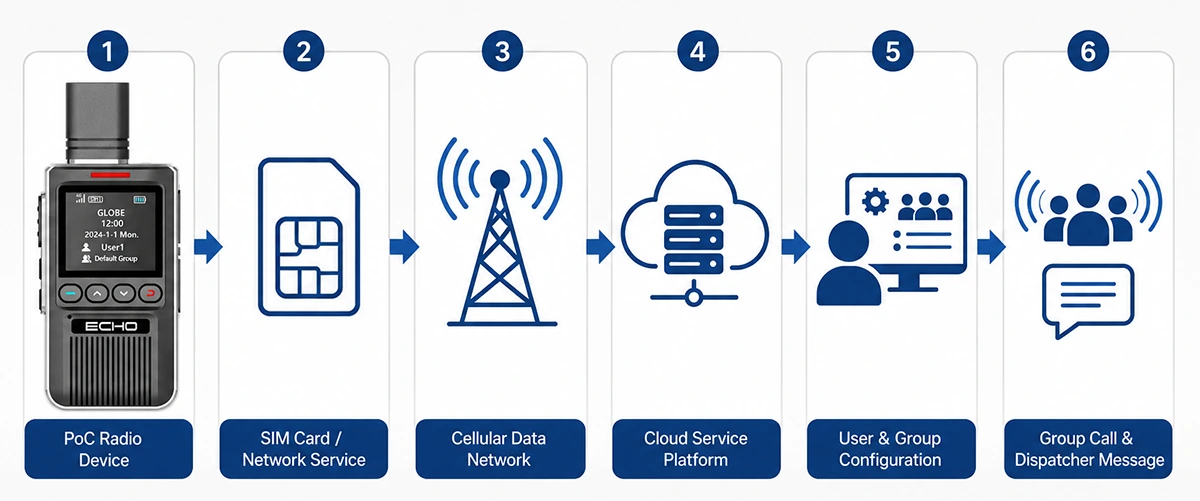
This does not mean every project must be configured in exactly the same way. Different customers may use different operators, platforms, and service providers.
But the logic is useful for project planning. It reminds buyers that push-to-talk communication is not only about the radio hardware. The network and service layer also need to be ready.
For B2B projects, this is especially important because the buyer may not be the final user. A distributor, reseller, system integrator, or project contractor may need to explain the full communication setup to their own customer.
Cloud SIM Does Not Replace Project Planning
Cloud SIM can make PoC radio deployment easier in some situations, especially when users need more flexible network and operator management.
But it does not replace project planning.
Buyers still need to confirm where the devices will be used, whether cellular network coverage is available, which SIM or service plan will be used, how user groups will be organized, and whether dispatcher functions are required.
This is the most responsible way to evaluate a PoC radio project.
Cloud SIM is valuable because it can reduce management complexity. Multi-operator compatibility is valuable because it can improve flexibility. Dual SIM support is valuable because it gives buyers more physical SIM options.
But none of these features should be understood as a guarantee that the device can work anywhere without network conditions.
FAQ
Is Cloud SIM the same as a physical SIM card?
Not exactly. A physical SIM card is inserted into the device for cellular network access. Echo3 normally requires a physical SIM card for use. Cloud SIM service helps simplify operator selection, activation, or network service management in supported configurations.
Does Echo3 work immediately after purchase?
Echo3 is a PoC radio hardware device. To use it for push-to-talk communication, customers need a valid SIM card or supported network service, available cellular data coverage, and the required PoC service, account, or group configuration.
Does Cloud SIM mean the PoC radio can work everywhere?
No. Cloud SIM still depends on available cellular or data network service. If the working area has poor network coverage, communication may still be affected.
Why does multi-operator support matter?
Multi-operator support can help mobile teams work more flexibly when one operator does not provide strong coverage in every location. It is useful for users moving across different work areas.
Is Echo3 a traditional two-way radio?
No. Echo3 is better understood as an LTE PoC radio. It supports push-to-talk communication through cellular or data networks, instead of traditional VHF or UHF RF communication.
Conclusion
SIM, Cloud SIM, and network planning are important because PoC radio communication depends on more than the device itself.
For Echo3 and similar LTE-based PoC radios, buyers should understand the relationship between the physical SIM card, cellular network coverage, operator service, PoC platform, and group configuration. These elements work together to complete the communication workflow.
Cloud SIM can help simplify network and operator management in supported configurations. Dual SIM and multi-operator compatibility can also provide more flexibility for mobile teams. But PoC radios still depend on available cellular or data network service.
For security, logistics, facility management, industrial operations, and field service teams, Echo3 can be considered when the project requires LTE-based push-to-talk communication, group calls, dispatcher messages, and flexible mobile team coordination.
The best result comes from choosing the right device and confirming the right network and service setup before deployment.
PoC Radios for Security, Facility, and Mobile Teams
PoC Radio vs Traditional Two-Way Radio: What Is the Difference?
Related Article